Wireless patient monitoring systems
Wireless Patient Monitoring Systems for Care Homes
Scattered care records, manual night rounds, and delayed incident alerts are the three biggest time costs in most care homes. Wireless monitoring systems address all three.
This guide covers how these systems work, what to look for, and how to match a system to your setting.
Definition
What is a wireless patient monitoring system?
Systems track heart rate, oxygen saturation, movement, and activity patterns in real time. Data collection is continuous, not point-in-time snapshots at scheduled check-ins.
Traditional bedside monitors use physical cable connections that confine patients to a fixed clinical location. Wireless systems use IoT sensors and wearables, so residents can be monitored anywhere in the facility, continuously throughout the day.
How it works
How wireless patient monitoring works
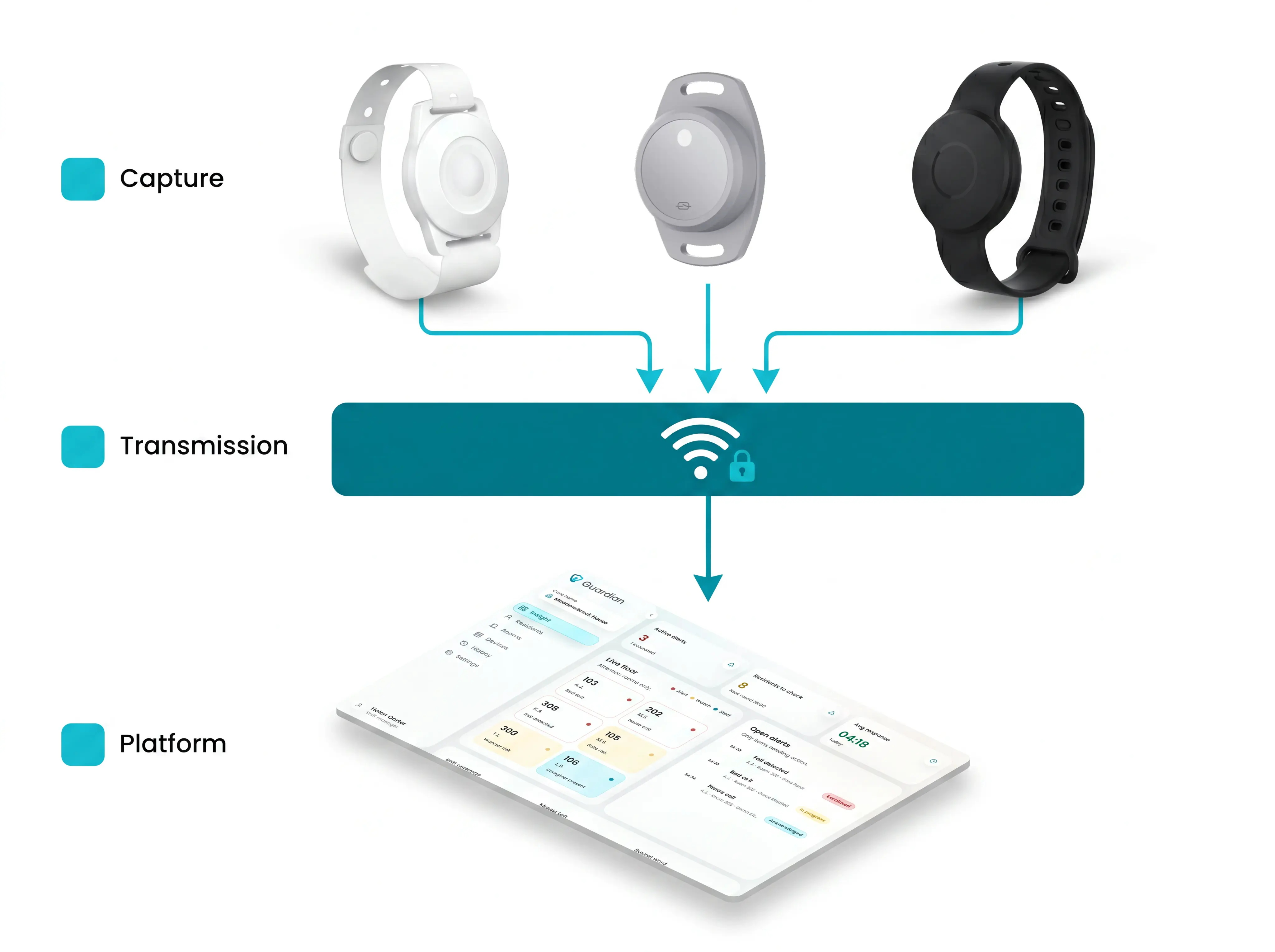
The platform analyses the data to surface trends and trigger alerts for care staff.
Capture layer
Transmission
Platform
System layers
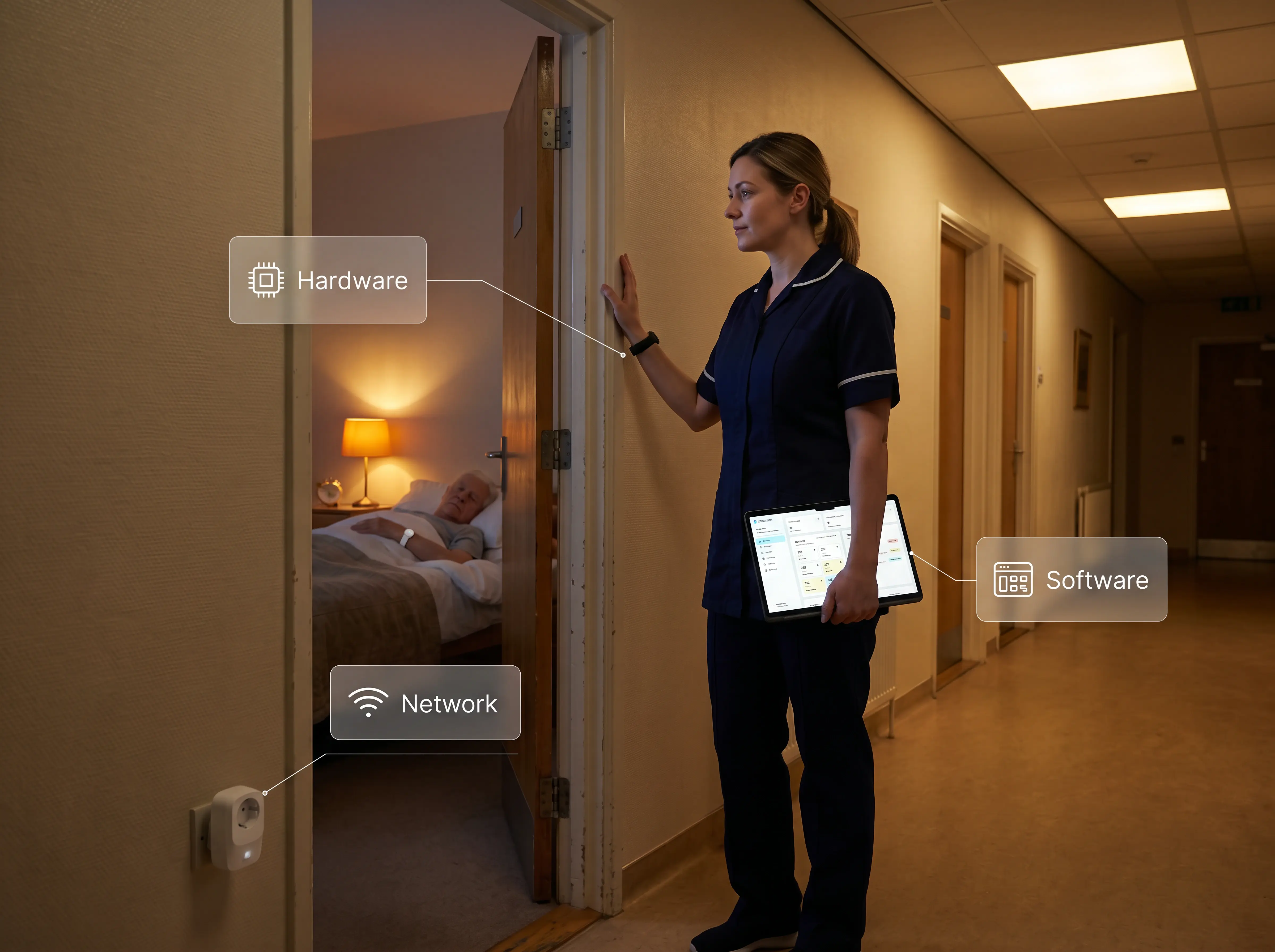
Core components of a wireless monitoring system
Each layer has specific requirements. A gap in any one breaks the chain.
Capture layer
Sensors and wearable devices
Activity and safety sensors
Smartphone apps and BYOD wearables
Connectivity
Wireless connectivity and network infrastructure
IoT protocols run over Wi-Fi, cellular, or low-power networks, with encryption protecting data in transit.
| Protocol | Best for | Deployment note |
|---|---|---|
| Wi-Fi | Most care homes | Uses existing infrastructure; fast to deploy |
| Cellular | Remote or rural sites | No reliance on facility Wi-Fi |
| LPWAN | Always-on low-power sensors | Reduces battery drain; needs coverage survey |
Operations view
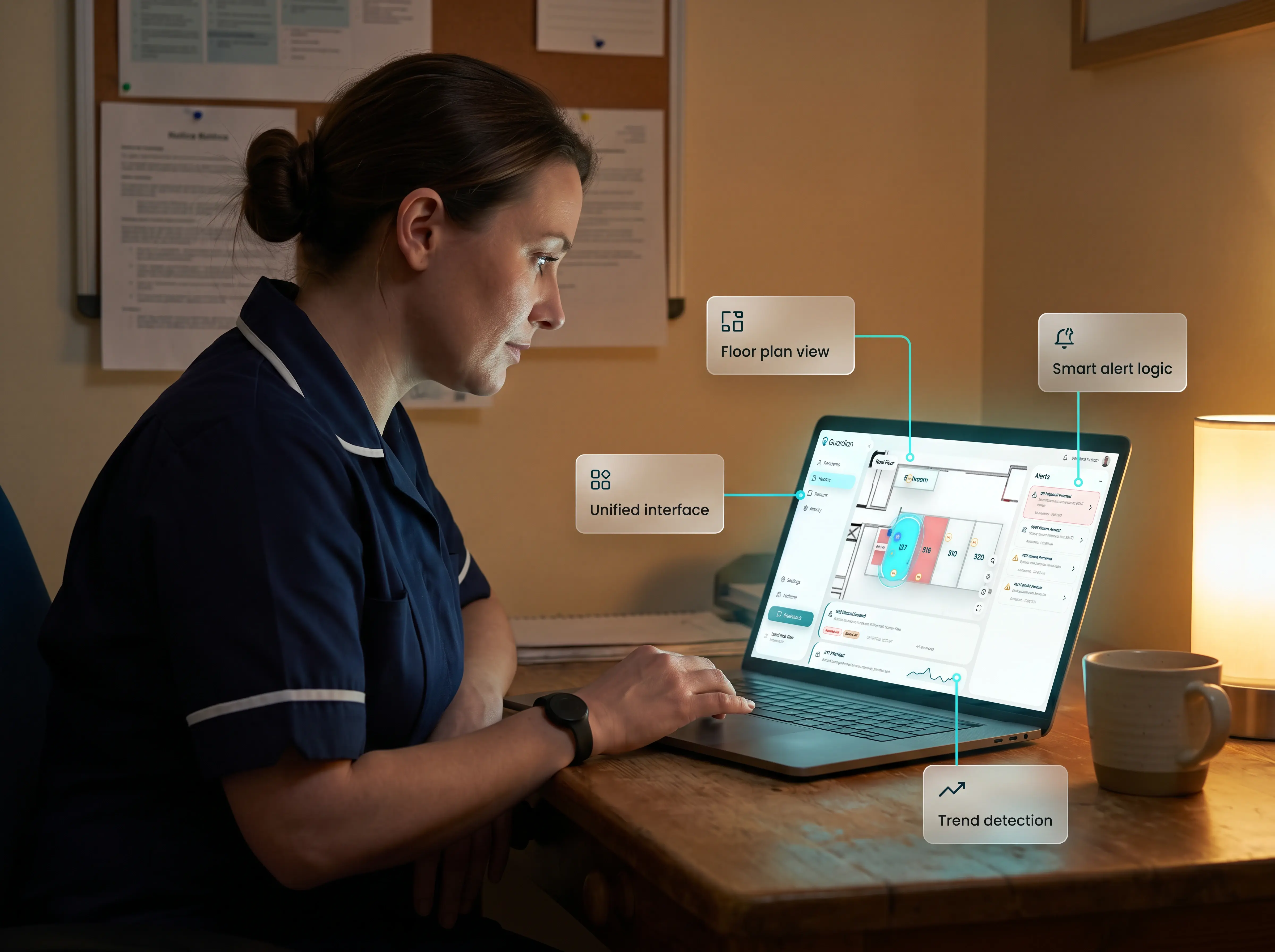
Monitoring dashboard and alert logic
Floor plan view
Unified interface
Smart alert logic
Trend detection
Signals
What wireless patient monitors can track
| Clinical vitals | Activity and safety signals |
|---|---|
| Blood pressure (smart BP cuff) | Motion (room-level sensors) |
| Heart rate (chest strap or wristband) | Bed exits (fall-risk residents) |
| Blood glucose (CGM) | SOS triggers (wristband or fixed call point) |
| Oxygen saturation (pulse oximeter) | Cardiac rhythm (continuous monitor) |
| Respiratory rate (respiratory monitor or validated wearable) | Glucose trends (CGM alerts) |
| Body temperature (wearable thermometer) | Sleep disruption patterns |
Settings
Where these systems are commonly used
| Setting | Primary monitoring focus |
|---|---|
| Hospital ward | Acute vitals and exception alerts |
| Care home | Safety events: motion, bed exits, SOS |
| Home | Recovery indicators and chronic disease management |
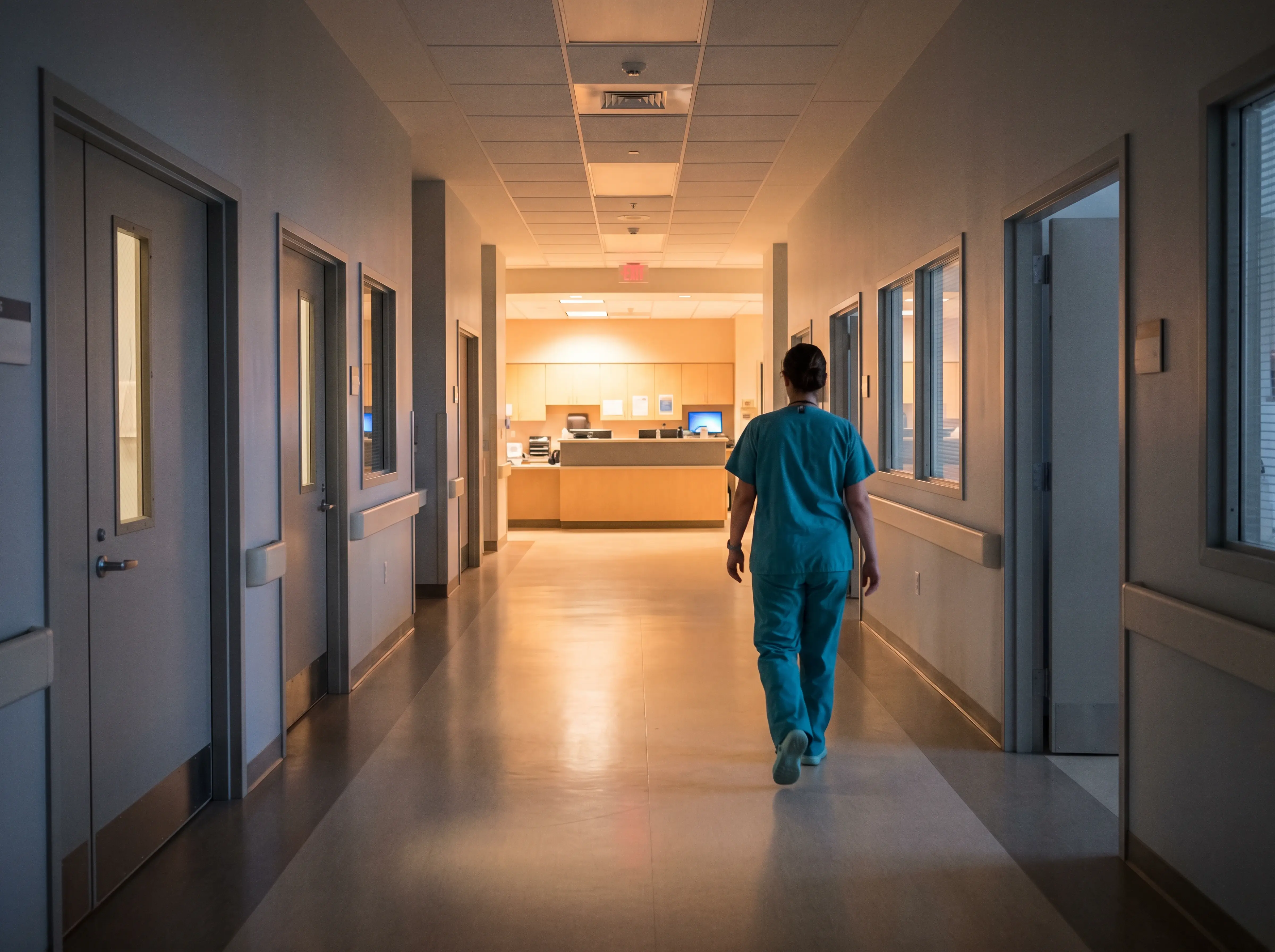
Hospital wards and general care settings
- Cardiac units use continuous monitoring to detect arrhythmias and heart rhythm irregularities in real time
- Post-operative recovery, COPD management, and hypertension are the most common ward-level use cases
- Staff shift from checking every patient on a schedule to responding only when an alert fires
Care homes and residential facilities
- Sensor suites cover motion, bed exits, and SOS call points with no cameras, preserving resident privacy and dignity
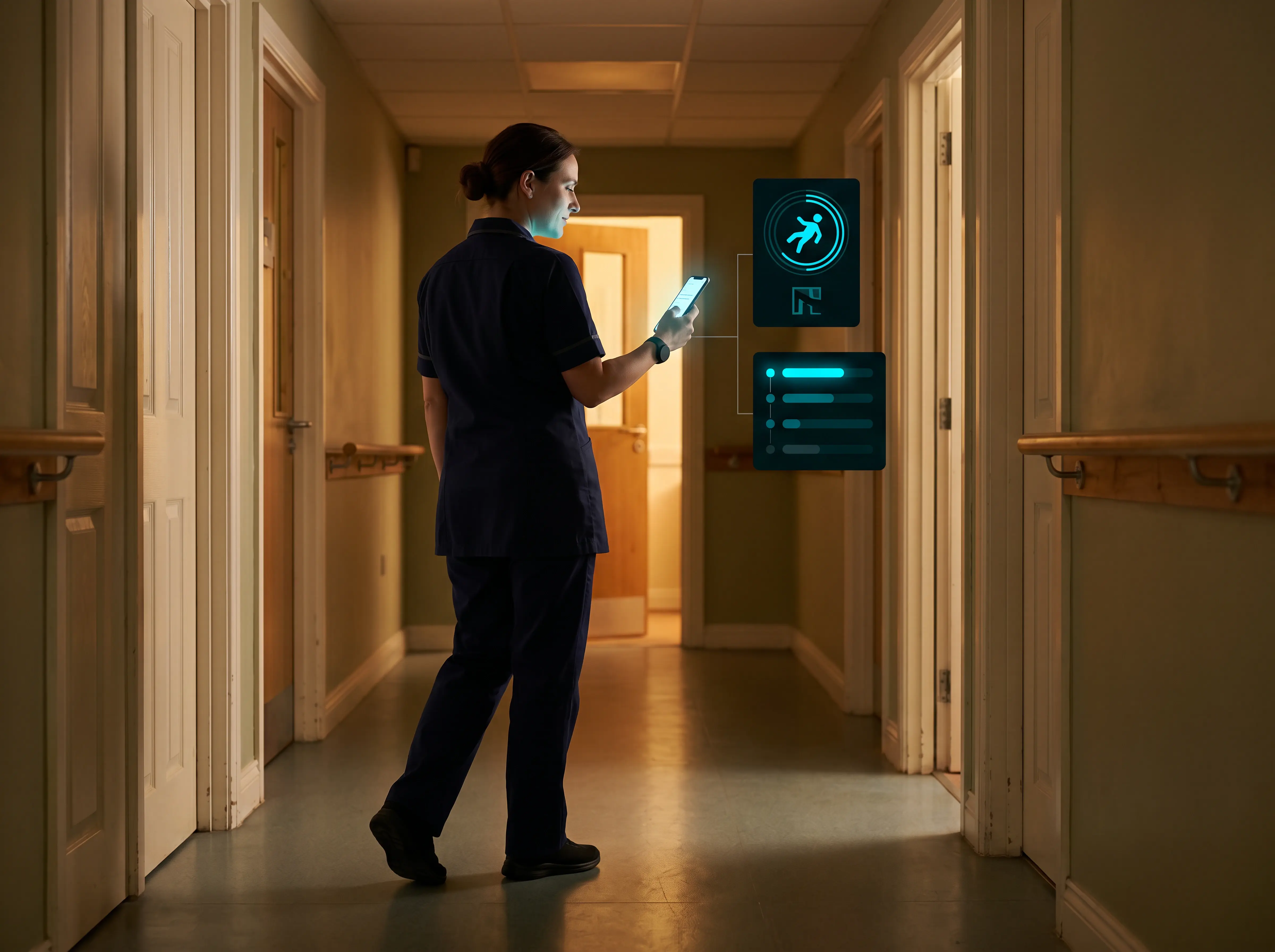
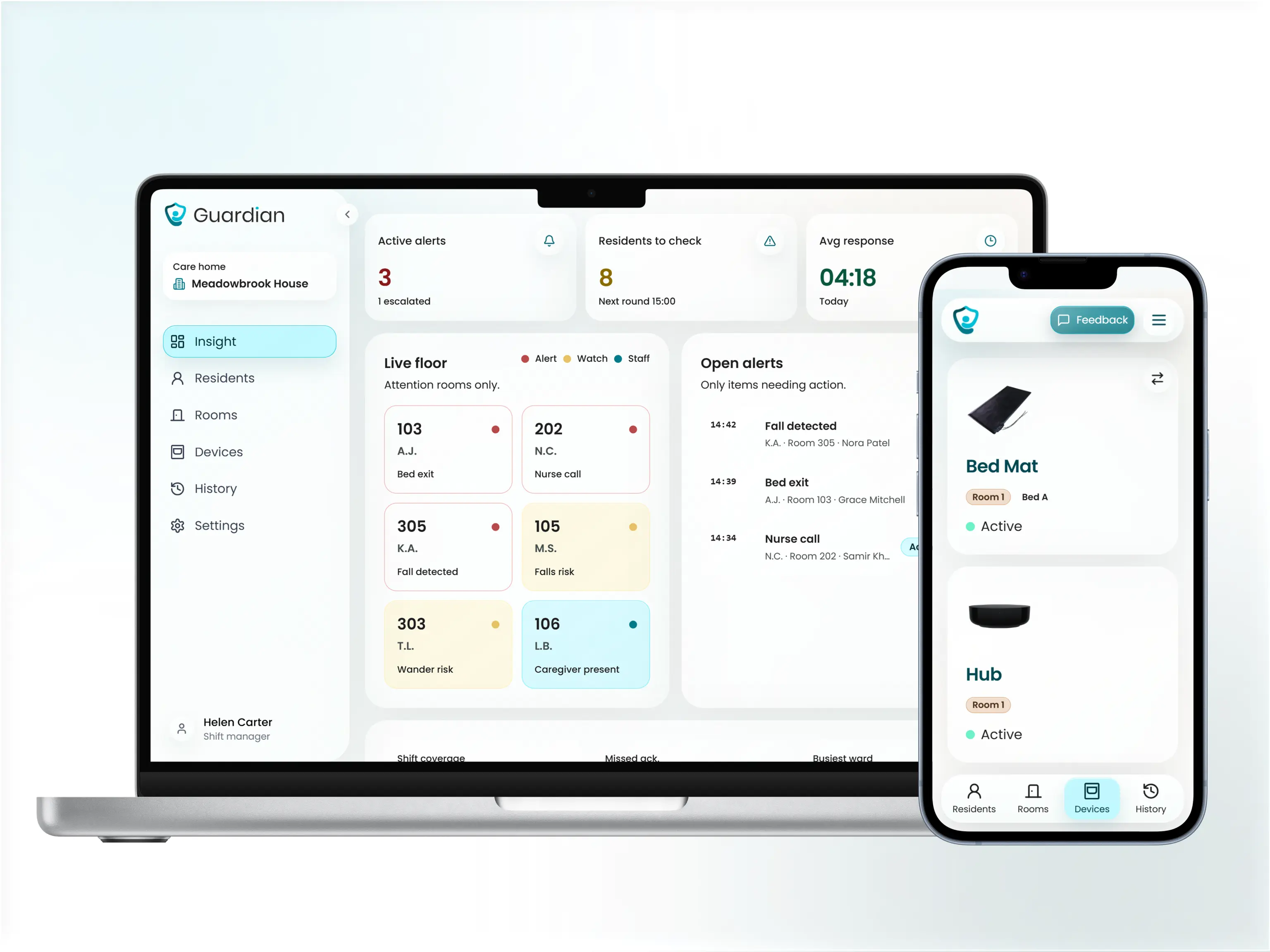
- Alerts map to a floor plan dashboard so carers see location-aware notifications across the whole facility from one screen
- Platforms are configured to reduce false alarms so carers respond to genuine incidents, not constant low-priority notifications
Tip: Log your manual round count per shift before go-live. After 6–8 weeks, compare it to Guardian's automatic visit records. That gap is your baseline.
Home and post-discharge monitoring
Each setting places different demands on alert logic, sensor choice, and deployment approach. This is why the right system for an acute ward is rarely right for a care home.
Buying criteria
How to choose a wireless patient monitoring system
Data security belongs in that checklist too. Choose systems with access controls, GDPR compliance, and camera-free design. Passive sensor monitoring limits personal data exposure compared to camera-based alternatives.
Evaluate any system against three questions:
- Does it fit how staff already work?
- Can you measure the return in response times and reporting hours saved?
- Does it meet GDPR and privacy requirements?
Fit
Usability and patient comfort
Staff alerts go to devices they already carry
Residents tolerate passive sensors better than wearables
Ask vendors this before signing
For most care homes, a standalone system on existing Wi-Fi is enough to start. Integration can come later for larger rollouts.
Alert quality
Alert quality and escalation logic
If fall-specific coverage matters, the fall-detection medical alert roundup compares wearable, passive, and facility-grade options.
Configurable smart rules filter normal behaviour
Location-aware alerts attach name and room
Worked example
Pilot benchmark
Unacknowledged alerts escalate
One caveat
Scale
Integration and scalability
Low-friction deployment takes about one week per ward
A scalable system covers multiple wards or sites in one view
The system writes timestamped visit and incident logs automatically
Implementation
Common implementation challenges
- 1
Data security and privacy compliance
GDPR Article 32 requires risk-appropriate technical and organisational measures for health data — including encryption, access controls, and regular testing where appropriate.
For connected monitoring devices sold in the EU, EU MDR (Regulation 2017/745) applies. Systems marketed as medical devices must meet secure-by-design requirements under that regulation.
Camera-free hardware (motion and bed exit sensors) reduces personal data exposure by monitoring activity patterns without capturing visual data.
For care home deployments, EHR integration is not required to go live. - 2
Alert fatigue
Up to 99% of monitoring alarms in clinical settings are non-actionable, according to The Joint Commission's alarm safety National Patient Safety Goal. ECRI also ranks alarm fatigue among its top health technology hazards.
Staff develop alert blindness over time, so genuine events go unnoticed.
Intelligent alert logic with contextual thresholds and delay filters distinguishes routine resident movement from real safety events before an alert fires. - 3
Building infrastructure and connectivity gaps
- Get a pre-deployment site survey that maps Wi-Fi coverage and identifies dead zones.
- Run sensors in a test pattern for 48 hours before full installation.
- Choose a turnkey system that includes the network assessment as part of onboarding.
Guardian in care homes
How Guardian works in a care home
In one Estonia pilot, the system attended 30 potential fall situations on a single ward, catching events that would have surfaced only on the next round.
Pilot flow
Deployment takes one week, not one quarter
Week 1
Pilot
Deliverable
Live ward layers
Once live, Guardian runs three layers on your ward in parallel
Sensors
Portal
Alert logic
FAQ
Answers to common questions
Is remote patient monitoring worth it? +
What are 5 examples of IoT used in healthcare? +
Wearable sensor accuracy varies by device and vital sign. Validation studies show strong results for select measures; check device-specific certification data before deploying in clinical settings.
How is patient data kept secure? +
- AES-256 encryption at rest, TLS 1.3 in transit
- RBAC on the Portal dashboard, MFA, and network segmentation
- Motion and bed sensors avoid cameras entirely, minimising personal data exposure
The platform is built to meet GDPR Article 32 obligations for health data processing and EU MDR secure-by-design requirements for connected medical devices.
See Guardian live in your ward
Pilot Guardian in one ward.
No cameras. No drilling. No IT project.
Author
Aleks Timm
Aleks Timm leads Guardian and builds privacy-first operations technology for care homes and home care providers. Teams get location-aware alerts they can act on, clearer situational awareness, and measured insight into how care work actually runs.
Read MoreRecommended reads
Keep reading

7 Best Care Home Audit Tools for Care Homes (Compared)
7 best care home audit tools compared: find CQC-ready options, pricing, and action tracking to streamline audits and improve...
Read more
11 Best Nursing Home Software Options: What Actually Works
11 Best Nursing Home Software Options: Compare tools for live alerts, compliance, and EHR integration to find what actually works.
Read more
Smart Nurse Call Systems for Care Homes and Home Care Providers
Smart nurse call systems for care homes and home care providers: compare features, improve response times, and choose the right...
Read more